
He Must Increase. I Must Decrease.
Should women imitate John the Baptist?

After this, Jesus and his disciples went out into the Judean countryside, where he spent some time with them, and baptized. Now John also was baptizing at Aenon near Salim, because there was plenty of water, and people were coming and being baptized. (This was before John was put in prison.) An argument developed between some of John’s disciples and a certain Jew over the matter of ceremonial washing. They came to John and said to him, “Rabbi, that man who was with you on the other side of the Jordan—the one you testified about—look, he is baptizing, and everyone is going to him.”
To this John replied, “A person can receive only what is given them from heaven. You yourselves can testify that I said, ‘I am not the Messiah but am sent ahead of him.’ The bride belongs to the bridegroom. The friend who attends the bridegroom waits and listens for him, and is full of joy when he hears the bridegroom’s voice. That joy is mine, and it is now complete. He must become greater; I must become less.” John 3:22-30 NIV (bold mine)
I continue to work my way through the Ignatian Spiritual Exercises and am loving it. The discipline of rising early each day, and meeting weekly with a spiritual director is nourishing me in the richest of ways. I notice myself moving out of a season of angst as I continue to both heal from past hurts and reckon with my own Christ-following, female awakening. It’s as if I’m being reacquainted with an old friend (the Bible), but able to show up in the relationship more centered and mature.
However, nothing triggers those old angsty feelings like being asked to interact with the statement “He must increase; I must decrease” and consider what it means for my life today. (cue the record scratch)
The version of the exercises I’m working through ask me to reflect on two questions in response to Johnny B’s statement….one I find tricky, and the other has potential if we do some re-defining:
Question 1: How have I demonstrated such freedom and other-centeredness? (tricky)
Question 2: Where in my life do I still need to let go of excessive self-preoccupation and control? (potential)
Let’s examine, shall we? Ultimately I’d like (for the umpteenth time) to make the case for why having an understanding of male vs female spirituality is crucial when reading, teaching, and applying the Bible to one’s life.
The Distinct Male & Female Journeys
If you’ve read Permission to Matter: Reclaiming Women’s Humanity and Authority at the Invitation of Jesus, this will be a quick refresher.
Christian Spiritual Formation is the journey of becoming most fully human, most fully who God created us to be. As we read and interact with the Bible (like John 3:30), we consider what the text means and is asking of us, as we participate in this process of becoming.
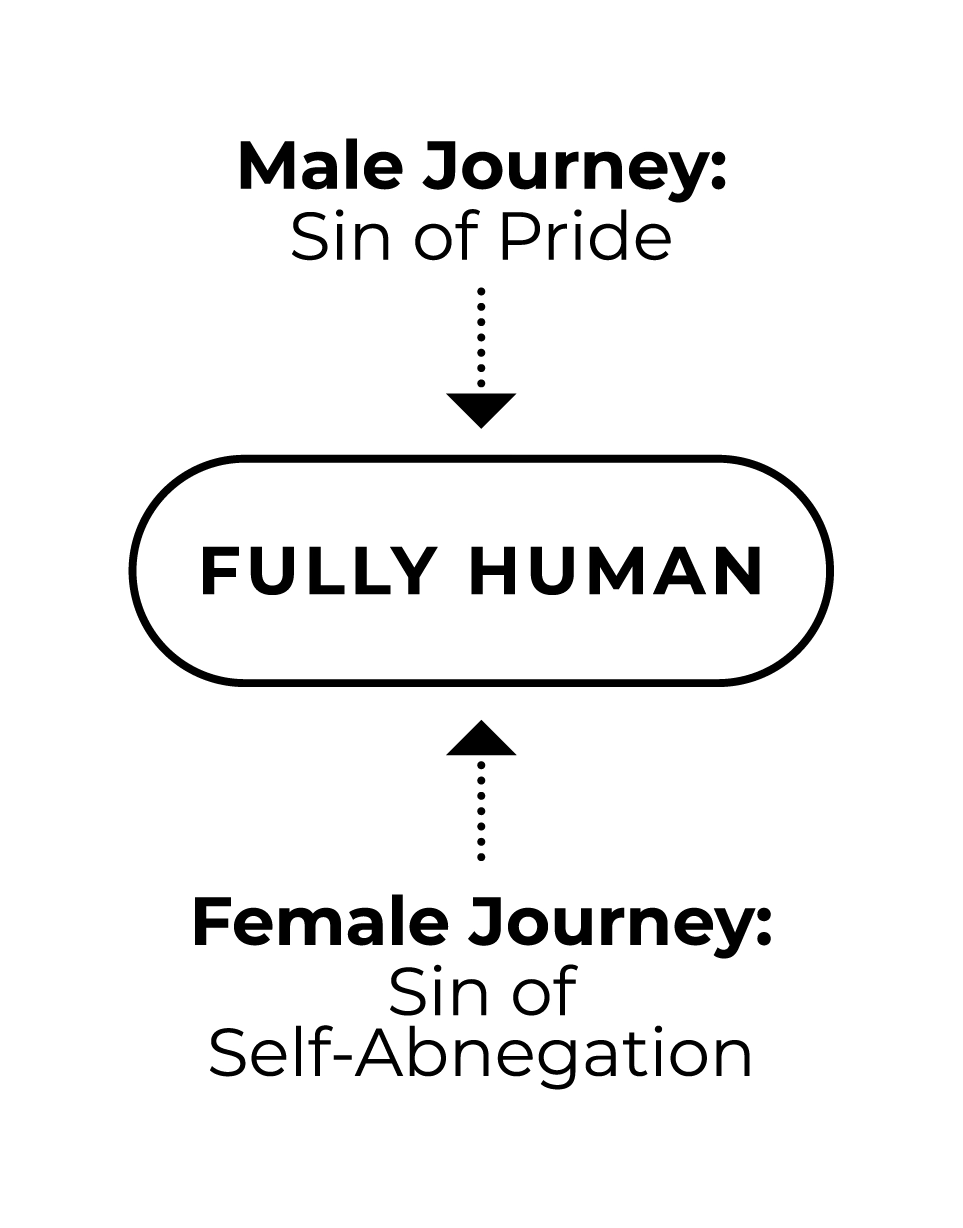
Historically, there has been an assumption made about this journey: that it is one-size-fits-all. And, no surprise, that one size happens to be male in its measurements. It assumes that the primary sin humanity must contend with is that of pride—of attempting to be more than human—and that the necessary response, then, is that of spiritual descent or decrease.
It makes sense: If we are getting too big, it’s time to get smaller, but is this typically an issue for women? According to Carol Lakey Hess,
“A representation of sin as self-assertion, self-centeredness, and pride speaks out of and to the experience of powerful men…women are better indicted for such things as lack of self, self-abnegation, and irresponsibility.” Caretakers of our Common House p 34-35
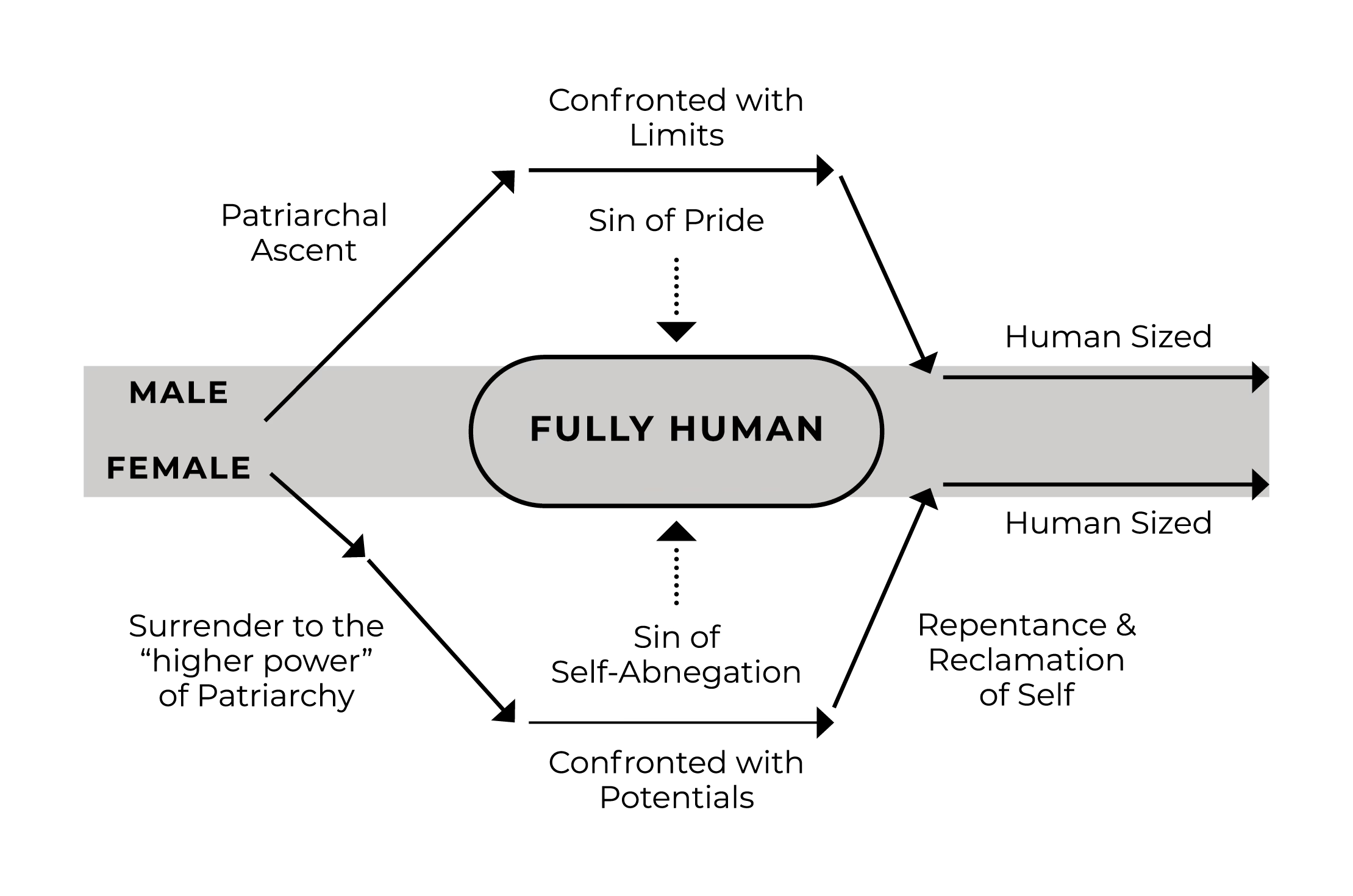
To be a man in a (patriarchal) world is to be told, “You must be more than you actually are,” whereas to be a woman is to be told, “You must be less than you actually are.” Both messages are harmful because both resist our full, God-given, exactly-sized humanity. If a man is getting a little too big for his britches, it is very good advice to decrease. To ask a woman to decrease, on the other hand, is to ask her to move further into sin—further into being something other than who God created her to be.
Women need to be given an accurate spiritual journey framework—one that invites them into their full humanity by increasing as they reclaim and step into all that patriarchy has asked them to deny. All who (regardless of gender) lead others in spiritual formation, need to read and interpret the scripture through a more holistic spiritual journey model.
Otherwise, we are leading people astray.
Back to Johnny B
Although eccentric in his food and clothing tastes, and likely a bit creepy to the local kiddos, John the Baptist held a significant amount of power.1 How do I know this? First, he was a man. Second, he was a religious leader. Third, people were asking if he was the Messiah.
Thankfully, Johnny B serves as an excellent example of what it is to be self aware. He knew who he was, and what was his to offer the world. He could recognize when people were wanting to give him an inappropriate amount of power (disproportionate to who God created him to be), and stepped into his full humanity by moving into descent.
What if instead of emphasizing the line about decrease in verse 30, we were to go back a few lines to where JB says, “A person can receive only what is given them from heaven”? Each of us can only be exactly who God created us to be—exactly human sized. For Johnny B, who was being asked to be something of Messianic proportions, the necessary move was to become less.
Rather than assuming we must all follow in the exact footsteps of JB, we can allow him to be an example of what it is to know what is uniquely ours (from God), and live in alignment. As a woman, I can look to his thoughtful example, imitate his ability to recognize power dynamics, and notice the difference in what the world is trying to give me (or often withhold from me) and what is actually mine “from heaven,” and then make the move into my full humanity too.
With this in mind, let’s return to those reflection questions:
Question 1: How have I demonstrated such freedom and other-centeredness? (tricky)
Question 2: Where in my life do I still need to let go of excessive self-preoccupation and control? (potential)
Question 1 is tricky because the idea of “other-centeredness” for women is as loaded as a baked potato. As Carol Lakey Hess points out, “The promotion of self-sacrifice occurs for women before there is a self to give away.”2 Before asking a woman this question, she first needs to be invited into exploring the self. Who is she? Who did God create her to be in all her God-given, image bearing, exactly-sized human fullness? Only then can she emulate John the Baptist in stewarding her life, and discerning what to pick up and what to set down.
Question 2 has potential because of how we might reframe “excessive self-preoccupation.” Being overly self-focused doesn’t just mean thinking too much, or too highly of the self. It can also mean thinking too little, or in a belittling manner. It is possible to become so focused on staying small and “acceptable” that our ability to love and serve others (in a healthy way) is impeded. The question can remain the same, but needs to expand to include the ways in which women spend too much time working to accommodate and stay small.
(As a personal example, I’m in a season of discerning some work stuff and one of the questions I’ve been asking is, “What is my container?” My friend Juli recently challenged me by asking why I’m spending so much time trying to be contained? Whew! Get yourself a friend like that.)
So go ahead, and consider these for yourself:
Question 1 reframed: What has God uniquely put in me to offer the world and how is patriarchal messaging (for men to be more than human; for women to be less than human) impacting my ability to steward my life?
Question 2 with expanded definition: Where in my life do I still need to let go of excessive self-preoccupation (overthinking my need to be big or small) and control?
The Holy Work of Increase
John the Baptist has much to offer us. To distill down what he has to teach us into one statement made about his own life (“I must decrease”), and then try to apply it to all, significantly undercuts his contribution in offering a spiritual journey we can all seek to emulate.
John knew who he was, and who he wasn’t. He acted accordingly. He sought his full humanity.
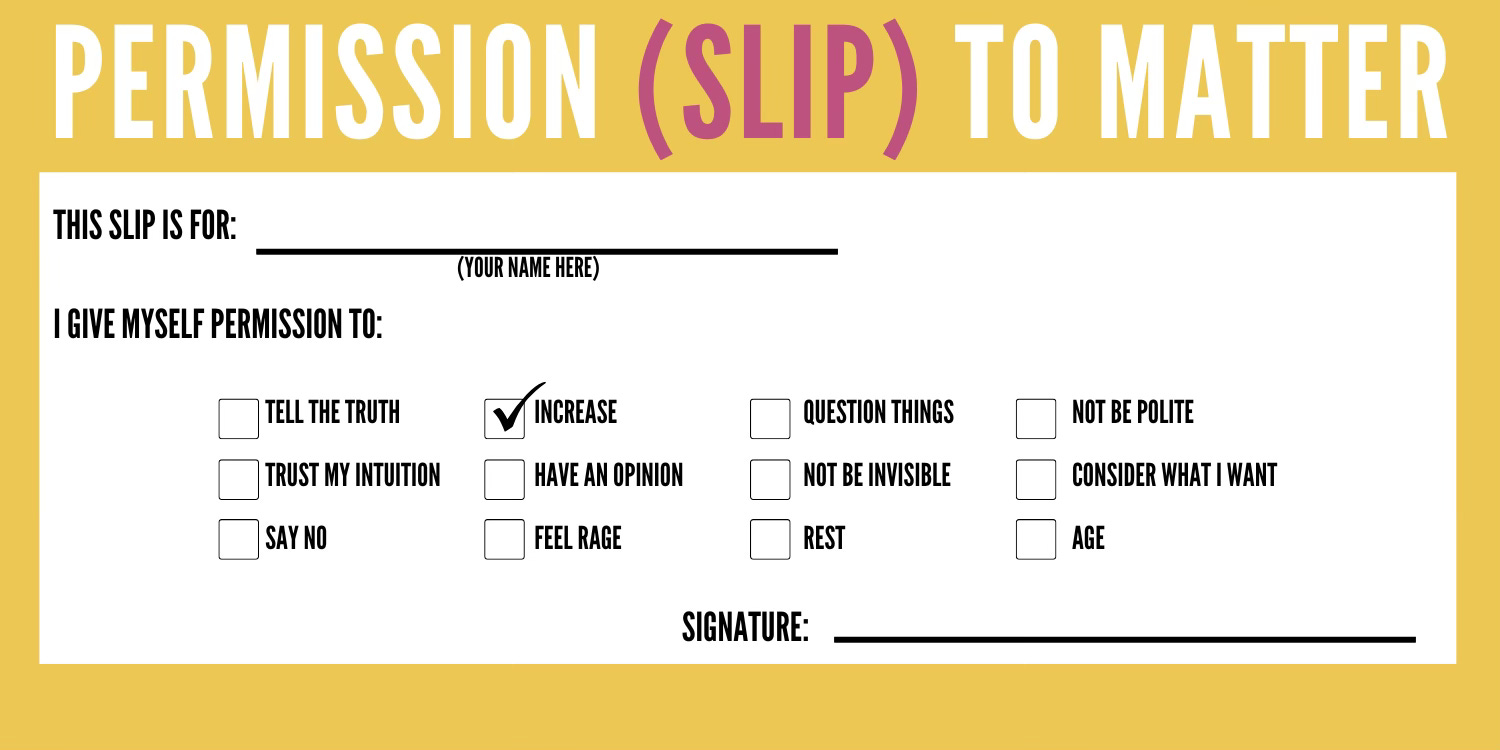
Should women imitate John the Baptist? Yes and no. Everyone can learn from Johnny B in considering what has been “given them from heaven.” But when it comes to the path forward, women need to be invited into the holy work of increase.
Friends, just a reminder: The pen is in your hand, as securely as your God-given authority and agency runs through your veins. It’s time to write your own permission slips, and story.3
This includes how you read and interact with the scripture.
Love, Bekah
P.S. In November I’m bringing back the monthly practice guides! The hope is to offer you a new Practice Guide (a series of prompts, questions, reflections) on the 1st of each month, inviting you into deep encounter with God and self.
I know, I know. In the context of the Roman empire, some might say Johnny B is a shrimp - a shrimp platter to be exact, as Herod only had to say the word and was given JB’s head. That might be a little crude, but I think it’s worth noting that even if he had less power than others, as a man his path still took on an upward trajectory compared to his female counterparts.
From Caretakers of our Common House, p 37.
From the intro of Permission to Matter.

Scheduling for Life Design & Discernment Mini-Intensives
If you are interested in working with me one-on-one before the end of 2025, please reach out. I currently have availability for the Discernment Mini in November & December, and availability for the Life Design in December and beyond.
A sweet message from a recent Life Design client:
“I had such an impactful two days doing the Life Design. You are very gifted at what you do through this program and I’m grateful to have experienced it.”
Love this, Becca! In the book as here, you do such a good job unpacking the "but what abouts" of putting others first or increase/decrease when it comes to men and women!
YES! I am so glad you wrote this piece. (And PtM.) I’ve been thinking the same thing lately: the Bible’s one-size-fits-all mandates and advice are absolutely written by, for, and about men. It’s time we started recognizing this in a corporate way.